Enterprise reporting on Copilot typically stops at two figures: the number of licenses assigned and the hours the tool is estimated to save. Connecting those figures to a financial outcome the business recognizes proves far harder, and the candid admission among IT leaders is that nobody really knows how to point to a spreadsheet and attribute a specific amount of savings to AI. That gap between activity metrics and financial proof is where ROI conversations tend to stall.
The gap reflects a measurement problem rather than an absence of value. Quilter, a UK-based wealth management firm, estimates that Copilot will save more than 13,000 hours of post-call administrative work per month for some of its most highly compensated staff, and its investment managers reached breakeven on the license within a month of deployment. Those figures were defensible because Quilter tied Copilot to a defined business process whose cost the organization could already quantify.
That distinction shapes everything that follows. Copilot ROI becomes measurable when the technology is embedded in business processes, pointed at the right data and connected to outcomes the organization already tracks. We examine why conventional spreadsheet-based measurement falls short and how process integration, build-cost comparison and disciplined adoption produce figures a CFO can accept.
Tying Copilot to Business Processes
Assigning a Copilot license creates the possibility of value, and nothing more. The return appears when the technology is integrated into a process that addresses a real business problem, such as monitoring project baseline costs, generating alerts when thresholds are breached or maintaining operational visibility that previously depended on manual reporting. At that point, the question shifts from how many licenses are active to what the AI-enabled process achieves.
The shift matters because processes have outcomes and outcomes have owners. A process that closes deals, delivers projects or resolves support tickets already carries metrics the business trusts, and Copilot’s contribution can be read directly against them. No universal calculation model works for every enterprise because ROI varies considerably between industries, business models and individual organizations, but the method of comparison transfers even where the numbers do not.
Comparing Traditional and AI-Assisted Delivery Costs
The most concrete version of that method prices what AI delivered against what traditional delivery would have cost. For example, a proof of concept that previously required $25,000 to $30,000 in external development can now be built internally in a couple of days. The gap between those two figures is a defensible number, grounded in costs the organization has actually paid before.
The same comparison extends beyond proofs of concept. Work that once required external consulting, contracted development or specialized resources increasingly gets done internally with AI assistance, and each instance carries a reference cost from the last time the organization bought that capability. Tracked over a year, those avoided engagements add up to an ROI figure that needs no speculative multiplier.
A CFO can interrogate this number in a way saved-hours estimates never permit, because every input has an invoice behind it. The comparison also captures the speed dimension, since delivery in days rather than months has planning value even before cost enters the discussion.
None of this materializes if Copilot cannot reach the information the process depends on, which makes data the next consideration.
Diagnosing Low Adoption
Consider an organization that has assigned 500 Copilot licenses and finds a significant share of users not engaging with the tool. The instinctive response is to treat the unused seats as a licensing problem and reclaim them, whereas the organization should have probed why people are not using them.
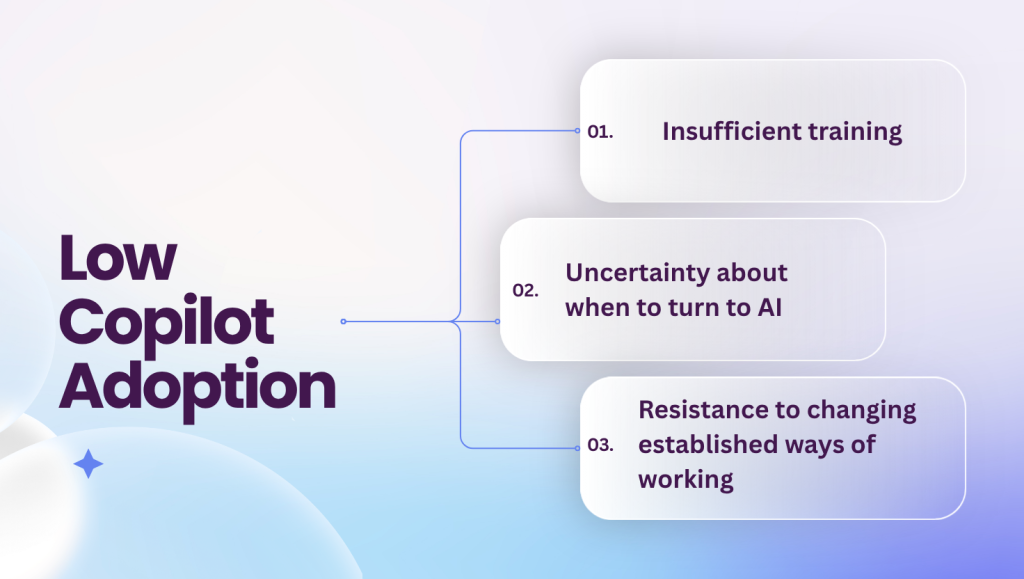
Low adoption more often points to insufficient training, uncertainty about when to turn to AI, doubts about output accuracy or resistance to changing established ways of working than to employees having judged the tool and found it lacking. Each of those causes has a different remedy, and none of them is addressed by reducing the license count.
Usage decline over time deserves the same scrutiny. When a critical repository becomes inaccessible or a policy change disrupts an established workflow, employees quickly lose confidence in AI-driven processes, and usage data records the loss before anyone reports it. A CIO needs to establish what happened and why before deciding on corrective action.
Approached this way, adoption metrics stop being a scoreboard and become a diagnostic, one that is only interpretable in the context of user experience, governance, permissions and business workflows. The conditions that drive strong adoption are not accidental, and the next section covers how organizations deliberately create them.
Governance and Structured Adoption
A sanctioned AI platform delivers a better user experience than unsanctioned tools because it is connected to the right repositories and business data. Copilot performs measurably better when it understands organizational context, and that context is provided by governance rather than something users can configure themselves. Better governance, therefore, feeds directly into higher output quality, which in turn accelerates adoption.
The alternative is to leave end users to figure out AI on their own. Without guidance on the right and wrong ways to use the technology, every employee runs a private experiment with inconsistent results, and the inconsistency itself erodes trust in the tool. Governance closes that gap through training, standard operating procedures that build consistent habits and clear direction on where AI belongs in a workflow.
The pattern across organizations is consistent. A structured adoption plan produces better outcomes than uncontrolled experimentation, and organizations that govern AI properly are considerably more likely to realize value from the investment. Governance in this sense is not a compliance overhead sitting apart from ROI, but rather one of the mechanisms that produce it.
Even with governance in place, returns do not arrive evenly across the organization, and knowing where they concentrate first helps leaders sequence the rollout. That is where the final section turns.
Departments Where ROI Appears First
Nearly every department has some opportunity to realize value from AI, but departments with structured workflows tend to benefit most from Copilot adoption. AI performs best when it moves through clearly defined steps, and workflows that can be visualized from beginning to end tend to be highly receptive to automation, optimization and acceleration.
That profile points to specific functions. Technical teams and IT support are among the strongest early candidates, since service and support work runs on exactly the kind of predictable, ticketed processes AI accelerates. Finance teams apply Copilot to model building and data-driven processes, while legal, procurement and contracting functions benefit from workflows built around structured documents and repeatable review steps.
For leaders sequencing a rollout, this concentration is useful rather than limiting. Departments with structured workflows adopt faster and produce measurable outcomes sooner, which generates the internal evidence that funds and justifies expansion into the rest of the organization. The early wins are also the easiest to measure with the delivery-cost comparison covered earlier, since structured work is precisely the work an organization has historically priced and outsourced.
Conclusion: Measuring ROI as an Ongoing Process
AI delivers measurable value for organizations in ways a spreadsheet cannot convey at a glance. The return spreads across processes, capabilities, and decisions, and it grows as employees find new uses, workflows change, and Copilot’s own abilities expand, meaning the value present at month twelve rarely resembles the value estimated at month one.
Cost savings cannot be identified in a single pass either. For many organizations, measurement begins as a one-off task and extends into ongoing work that ties specific outcomes in business processes to those savings.
This is what informs our approach at CrucialLogics, where we treat AI consulting, governance and training as an ROI-backed initiative rather than a deployment exercise. To get started, review our AI consulting and training services or book an AI readiness assessment.