Azure governance is designed to integrate threat risk assessment and the Azure environment into a single operational system. While many organizations assume that a connection already exists, it usually doesn’t.
The threat risk assessment (TRA) defines business risk, the required controls, and who owns them, while the Azure estate continues growing through new subscriptions, policy changes, migrations, and vendor integrations. Over time, the two drift apart into separate layers.
That disconnect usually stays invisible until something external forces it open. During an insurance renewal, an underwriter asks for evidence that privileged access is consistently enforced across production, or that logging retention and restore-testing procedures actually work as documented. In most cases, the controls already exist. What’s missing is a governance layer that can prove they’re operational, enforced, and continuously maintained.
Most organizations already run Azure Policy, Microsoft Defender for Cloud, and a documented TRA, yet these systems often operate independently rather than as part of a unified governance model. The gap isn’t the assessment or the tooling itself, but the Azure governance layer that should connect the two, which, in many organizations, was never fully built.
Why Your Threat Risk Assessment Stops at the Document
A Threat Risk Assessment is supposed to translate business risk into operational control requirements. It identifies what the organization is protecting, the threats that matter most, the controls needed to reduce exposure, and who owns those responsibilities. On paper, it creates the foundation for governance.
In practice, many TRAs stop functioning the moment the assessment is complete.
The document is approved, archived, and revisited only during audits or renewal cycles. Meanwhile, the operational environment continues to evolve on its own. Azure subscriptions expand, new workloads ship, vendors gain access, and exceptions accumulate. Before long, the environment that the TRA assessed no longer matches the one running in production.
This is where the misunderstanding sets in. Completing a TRA does not, by itself, operationalize governance. A documented control objective is not the same as an enforced control. A stated requirement is not evidence that the requirement is applied consistently across the estate.
This is the point where Azure governance stops being a documentation exercise and becomes an operational discipline.
Azure Governance Is the Layer Between Risk and Control
Azure governance is the discipline that connects business risk to enforced, demonstrable control. It determines what gets enforced, where it applies, who owns it, and how that enforcement is proven over time.
Azure governance is not Azure Policy, nor is it Microsoft Defender for Cloud, since those are instruments rather than the discipline itself. Governance is the operating model that provides direction and turns a TRA from a document into something operational.
When that operating model is missing, the failure takes on a recognizable shape. Controls drift out of alignment with the assessment that defined them, evidence exists somewhere in the estate but cannot be reproduced on demand, and responsibility for enforcement blurs across teams until no one fully owns it. These are not separate problems, but the same absence appearing in different places.
Producing evidence then becomes a manual exercise repeated from scratch every time someone asks for it. Governance drift, from a different perspective, is what an Azure estate looks like when risk and enforcement were never wired together as a single operating model.
This is the conversation an underwriter or auditor will eventually force, and governance is what allows an organization to have that conversation with itself first, while there is still room to fix what it finds.
From Risk Register to Enforced Azure Policy
A risk register only governs anything once each risk carries a control objective and a named owner. That ownership is what separates a requirement from a preference, and it is where the chain into Azure actually starts.
1) Mapping risk to policy
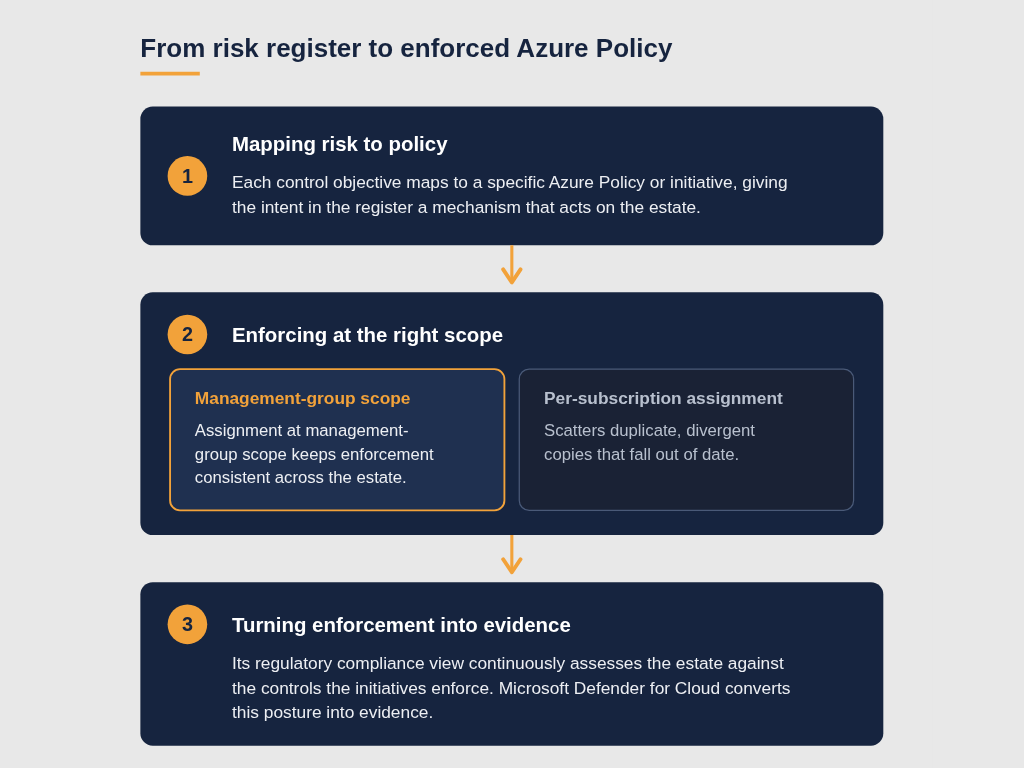
Each control objective maps to a specific Azure Policy or initiative, giving the intent in the register a mechanism that acts on the estate. Discipline matters more than coverage here. A tight set of initiatives tied to real risks governs better than an exhaustive library, because sprawl creates noise that hides the drift you need to see.
2) Enforcing at the right scope
Where initiatives are assigned decides whether enforcement holds. Assignment at the management-group scope keeps enforcement consistent across the estate, while per-subscription assignment scatters duplicate, divergent copies that fall out of date.
Legitimate exceptions belong in documented exemption objects with an owner and an expiry, so a temporary allowance never quietly becomes a permanent gap.
3) Turning enforcement into evidence
Microsoft Defender for Cloud is what converts this posture into evidence. Its regulatory compliance view continuously assesses the estate against the controls that the initiatives enforce.
The practical test is reproducibility: evidence that can be regenerated on demand shows the governance model is operating, while evidence that takes weeks to assemble shows it has already drifted.
What Your Cyber Insurance Renewal Actually Tests
A few years ago, a cyber insurance renewal turned on what you were willing to attest to. You confirmed the controls were in place, signed the questionnaire, and that was enough. That era is over, and the renewal you are walking into now asks you to prove what you previously only declared.
The controls underwriters ask about are predictable:
- Multi-factor authentication enforced on every privileged account, not just the admins listed on paper
- Encryption at rest with customer-managed keys for regulated data
- Immutable backup with a recent restore test that someone actually signed
- Real segmentation between production and non-production, with an audit trail behind it
What changed is that an underwriter now wants the evidence, not the assurance that it exists. An exported Microsoft Defender for Cloud compliance report helps, but it increasingly arrives alongside operational evidence: a customer-managed key rotation log or the name of the person who signed off on the last restore test.
There is a cheap way to find your gaps before the underwriter does. Pull last year’s questionnaire from your broker and read it against your current Azure estate, marking every control where the answer is still yes but the evidence is no longer reproducible.
A TRA written before this shift is rarely under-scoped in the controls it names; it is under-scoped in the evidence it expects to produce. The organizations that renew well are not the ones with the most controls deployed, but the ones whose controls are demonstrable on demand.
How Governance Scales With Company Size
The need for governance does not change with company size. What changes is the complexity of keeping risk, enforcement, and evidence aligned as the environment grows.
1) Small organizations
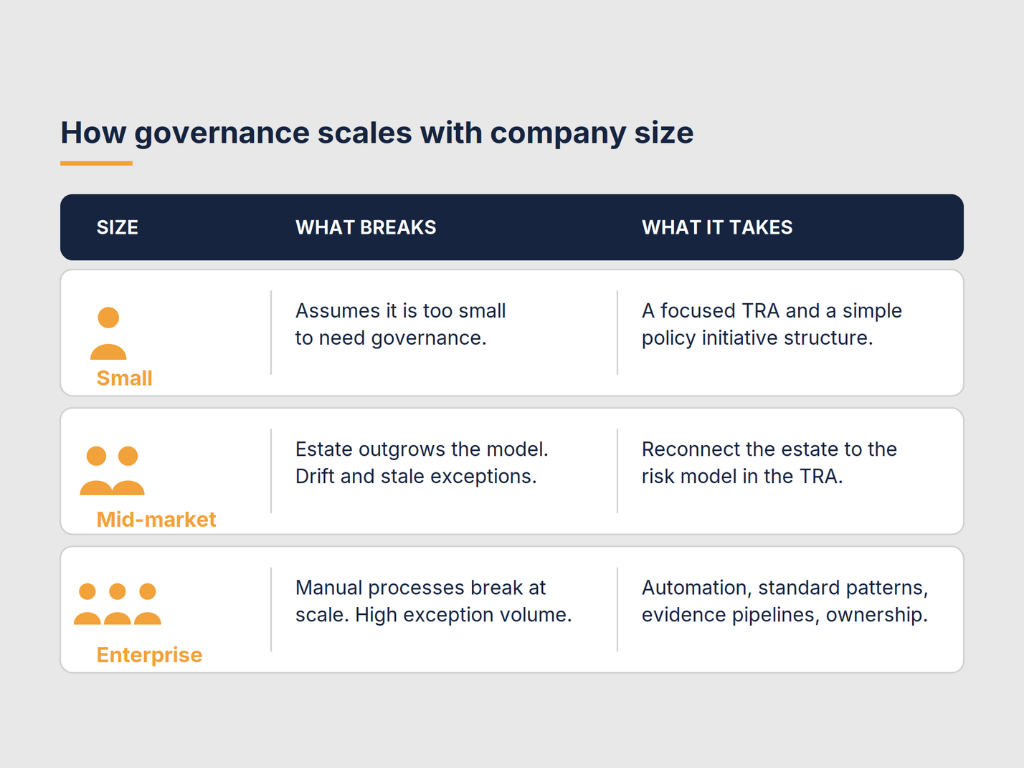
Smaller organizations often make the mistake of treating governance as something they are too small to need. In reality, a 50-person company can face the same renewal scrutiny as a much larger organization. The difference is that governance at this stage does not need to be heavy. A focused TRA and a manageable Azure Policy initiative structure are usually enough to establish operational maturity without creating unnecessary process overhead.
2) Mid-market
Mid-market organizations tend to experience a different problem: drift between the original cloud design and the current operational reality. The Azure environment grows faster than the governance model maintaining it. New subscriptions appear outside the intended structure, policy assignments become inconsistent, and exceptions accumulate faster than they are reviewed. This is usually where organizations discover that the fix depends less on deploying new tooling and more on reconnecting the existing estate to the risk model defined in the TRA.
3) Enterprises
Enterprise environments introduce a different level of operational complexity. Governance becomes a continuous program rather than a discrete project. Multiple management groups, decentralized operational teams, regulatory overlap, and high exception volumes make it significantly harder to maintain consistency over time. At this scale, maturity depends heavily on automation, standardized enforcement patterns, documented ownership, and continuously reproducible evidence pipelines. Manual governance processes break long before the environment stops growing.
What stays constant is the requirement for alignment. At every size, the TRA needs a named owner, enforcement needs to be consistent, and evidence needs to hold up under scrutiny. The organizations that scale governance well are rarely the ones with the largest control libraries, but rather those that keep risk, enforcement, and evidence connected as the environment around them changes.
Conclusion: Reinforce Your Azure Governance Before Renewal
A Threat Risk Assessment rarely fails on the controls it chose; it fails when no governance layer keeps those controls operational as the Azure estate moves on without it. The gap goes unnoticed until a renewal or audit demands proof and that’s when missing controls start costing real money. Azure governance closes it, keeping risk, enforcement and evidence connected so the proof is ready before anyone asks.
Our approach starts with the TRA you already have. We read it against your live Azure estate, find where enforcement and evidence have drifted from the risk model, and build the governance layer that turns scattered controls into reproducible proof, generated in normal operations rather than assembled under a deadline.
The most effective thing you can do this quarter is find the gap before your renewal does. If a renewal or audit is close and you are not certain your TRA is still alive across your Azure estate, that is the conversation worth starting now. Our Microsoft experts can guide you through the assessment and the subsequent cybersecurity risk management work. Connect with our experts on next steps for your TRA or cyber insurance renewal.