Azure costs can spiral quickly and it’s rarely because of a single deployment. They balloon because standards fail to scale with consumption and most organizations don’t have a straightforward way to monitor spend, identify waste, or surface real saving opportunities. Every unmanaged subscription, oversized virtual machine, untagged resource, abandoned workload and duplicated instance compounds into operational policy debt.
Azure is built for operation-intensive workloads where usage maps directly to billing. But it also makes spending harder to interpret over time. Organizations begin struggling to understand why costs become unpredictable, why headcount and infrastructure spending drift apart and why optimization efforts repeatedly fail to create long-term stability.
The Chief Financial Officer (CFO) of a US-based aerospace components manufacturer we work with described the moment they noticed it. An Azure invoice crept up by roughly 30% over four quarters with no matching growth in workloads or headcount. The number itself wasn’t the surprise. The surprise was that nobody on the technology side could explain it.
That disconnect is what this article is about. Most Azure cost problems aren’t really cost problems. They are governance problems that eventually present themselves as an invoice.
What Azure Cost Management Actually Is
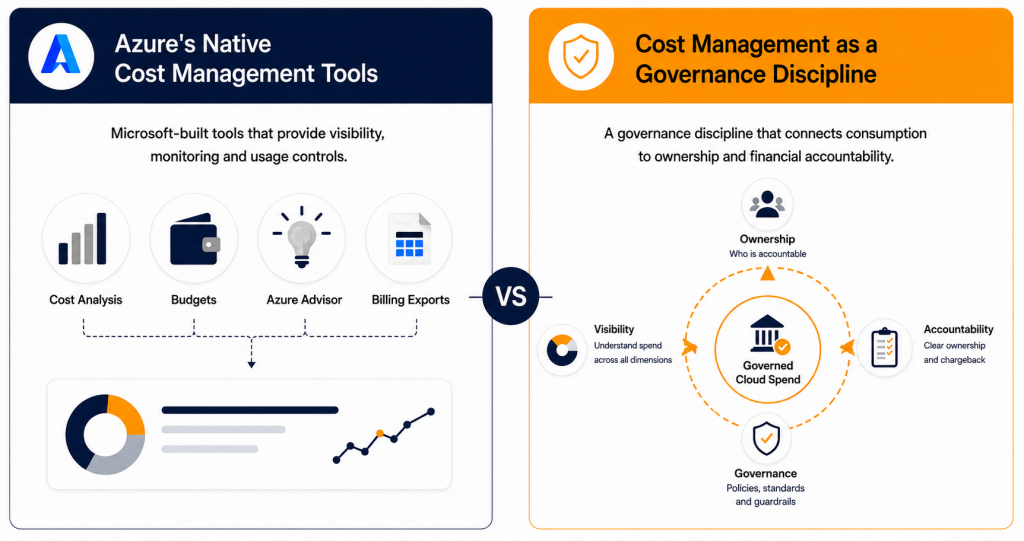
Azure cost management encompasses two distinct yet operationally close philosophies.
The first is Microsoft’s native toolset built into the Azure portal: Cost Analysis, Budgets, Azure Advisor, and billing exports. These provide baseline visibility and usage controls, with dashboards and monitoring that track spend and analyze billing.
The second operates at a higher level. Azure cost management is also a governance discipline, one that connects infrastructure consumption to ownership and financial accountability. It lets organizations understand how engineering decisions translate into financial outcomes across subscriptions, workloads, departments, and environments.
This distinction matters. Cloud costs are rarely caused by a single resource or one deployment mistake. In most environments, financial inefficiency emerges gradually, through fragmented provisioning, poor visibility, and inconsistent governance standards. The native tools give you dashboards and good visibility, but governance is what makes cloud costs predictable, and it does that work before optimization ever begins.
Why Azure Costs Become Unpredictable
Azure’s flexibility is one of its biggest operational advantages. Teams can provision infrastructure in minutes, scale workloads dynamically, and deploy services across regions without the procurement delays of traditional on-premises environments. But the same elasticity that enables speed also makes financial control significantly harder.
Five years ago, a Chief Information Officer (CIO) might have complained about an Azure bill because someone forgot to decommission a resource associated with a corporate credit card. Today, that same oversight can drive infrastructure costs to levels that directly affect operational margins. Four shifts explain why:
- AI adoption. Traditional infrastructure spending was largely capacity-based, which allowed organizations to estimate costs around servers, storage, and expected usage patterns. AI workloads break that model. Costs now fluctuate based on prompts, token usage, training cycles, inference demand, and data movement between services. That variability is far harder to forecast a quarter out.
- Kubernetes. Containerization abstracts infrastructure consumption behind orchestration layers that resist financial attribution. Multiple applications share the same cluster, workloads scale dynamically, and ephemeral resources appear and disappear continuously.
- Multi-cloud adoption. Many enterprises now run across Azure, AWS, and Google Cloud at once, often with different governance standards, tagging structures, and monitoring practices in each environment. The result is governance fragmentation and inconsistent financial visibility across platforms.
- Pay-as-you-go metering. Costs fluctuate continuously based on usage, workload behavior, and operational activity rather than fixed hardware ownership. When a developer forgets to decommission a resource, the meter keeps running, and the cost is added to the next invoice.
The 5 Layers of Azure Cost Management

1) Visibility
Cost optimization begins with attribution: clear sight of where Azure spend originates, which teams own which resources, and how workloads consume infrastructure over time. In practice, this starts with consistent tagging standards, subscription hierarchies, and management group structures that align cloud resources with business functions. You cannot allocate what you cannot separate, and you cannot govern what you cannot see.
2) Governance
Governance turns that visibility into operational boundaries that prevent uncontrolled sprawl. Azure Policy, resource quotas, region restrictions, and lifecycle enforcement let organizations standardize how infrastructure is provisioned and managed across the environment.
This layer has to precede optimization. Optimizing before governance is in place produces short-term savings while leaving the operational bottlenecks that caused the inefficiency untouched, so the savings erode and the problem returns.
3) Optimization
With governance controls in place, optimization turns to infrastructure efficiency: rightsizing virtual machines, eliminating idle resources, using reserved instances strategically, and automating shutdown schedules for non-production environments.
This is also the stage to evaluate workload architecture. Some applications are over-engineered for the business value they deliver. Others consume resources inefficiently because scalability decisions were made without financial accountability in the room.
4) Monitoring and Forecasting
Azure environments are dynamic, so cost management cannot stay a quarterly review exercise. Continuous monitoring is what lets organizations catch anomalies, usage spikes, and shifting consumption trends before they escalate into financial problems.
Tools like Azure Cost Management, Azure Monitor, and Azure Advisor do part of the work. Mature organizations go further and set budget thresholds and operational alerts tied to specific workloads or business units, rather than relying on finance oversight alone.
5) Automation and Lifecycle Management
Operational drift is one of the quiet engines of long-term Azure cost growth. Environments meant to be temporary become permanent, unused resources sit inactive, and governance standards weaken by degrees.
Automation sustains cost discipline without depending entirely on manual oversight. Automated shutdown schedules, policy enforcement, infrastructure-as-code standards, and lifecycle controls reduce the chance that resources stay active beyond their intended life.
- Related resource: An Introduction to the Azure Cloud Adoption Framework
FinOps: The Part Engineering Has to Care About
FinOps is an operational discipline shared across engineering, platform, and business leadership. The reason is structural: cloud costs are incurred operationally long before finance ever sees the invoice. By the time a number reaches the CFO, the decisions that produced it were made weeks earlier, in a deployment pipeline.
This is why FinOps puts the decisions that drive spend in front of the people making them. Kubernetes scaling policies, storage architecture, AI model usage, data retention, and workload design all shape the bill, and FinOps treats them as financial choices, not just technical ones.
It also closes the gap between engineering and finance. Engineering is usually incentivized around deployment speed, reliability, and scalability. Finance is measured on budgeting accuracy and control. Those two mandates pull in different directions, and the invoice is where the tension finally surfaces.
Mature FinOps alignment resolves this by moving toward cost-aware engineering, where infrastructure decisions are evaluated for technical performance and for operational efficiency and long-term sustainability together. Spend is judged on unit economics, such as cost per workload, cost per customer transaction, or cost per AI interaction, rather than on total cloud spend alone. A bill that grows is not automatically a problem. A bill that grows without a matching rise in transactions, customers, or output is.
The Three Things Every Cost-Controlled Environment We Run Has in Common
There’s no universal blueprint for Azure cost control. The governance model that works for ten subscriptions can fail completely at enterprise scale. But the environments that hold predictable Azure spend tend to share the same three operational characteristics: enforceable policy, disciplined tooling, and engineering accountability.
1) Policy: governance you can deploy, not governance you can email
Cost-controlled Azure environments enforce governance directly inside the platform. Resources without required tags are denied at deployment, approved VM SKUs are restricted through policy, and public IP attachment is blocked unless an exception exists. The more mature the environment, the more it treats policy exemptions as auditable artifacts with named owners and expiry dates, rather than permanent workarounds nobody revisits.
2) Tooling: consistency over sophistication
Operational discipline matters more than tooling complexity. Microsoft Cost Management usually provides enough visibility for budgets, alerts, and accountable reporting, while Azure Advisor recommendations, reservations, and auto-shutdown schedules cut unnecessary consumption over time.
3) FinOps culture
Azure’s pay-as-you-go metering means infrastructure costs scale directly with operational behavior. Kubernetes policies, AI inference demand, storage architecture, and workload design all move cloud economics over time. Cost discipline cannot sit with finance alone. It has to live in engineering, too, where the decisions that generate the bill are actually made.
Conclusion
Organizations that control Azure spend effectively rarely treat cost management as a standalone finance exercise. They run it as an operational governance program, one that combines policy enforcement, disciplined tooling, and engineering accountability under a shared ownership model.
At CrucialLogics, our approach starts with governance before optimization. That means Azure Policy enforcement, a deliberate tagging strategy, lifecycle controls, cost attribution, and monitoring, all tied to engineering accountability and measured against business outcomes. The sequencing matters as much as the controls themselves, because optimizing before governance just relocates the waste rather than removing it.
We also bring our own proprietary FinOps platform to the table. It connects to your Azure tenant and delivers monthly cost intelligence, including an executive spend summary, savings opportunities across reserved instances, right-sizing and orphaned resources, cost breakdowns by service and subscription, budget governance with automated alerts, AI-powered recommendations, and trend forecasting. It’s not a dashboard you log into and forget. No guesswork, no spreadsheets — just clear, prioritized actions reviewed with you every month.
If your Azure costs are getting harder to explain, forecast, or govern, the problem may not be the invoice. It may be the operational controls behind it. To find out where policy debt is accumulating in your environment, schedule a consultation with one of our Azure experts. Or review our Azure consulting services.