Enterprise data rarely lives in a single system. It spans cloud platforms and databases, SaaS applications and analytics environments, extending into business units across the organization. As that estate grows, organizations need a consistent way to know what data they have, who owns it, whether it can be trusted, and how it should be used.
An enterprise data governance strategy provides that consistency by setting standards for data ownership and discovery, then extending that structure to quality and security so use stays responsible. Microsoft Purview puts these principles into practice, creating visibility across the data estate and connecting technical metadata with business context.
With that foundation in place, this guide explains how to build a scalable governance strategy and where Microsoft Purview Data Map and Unified Catalog fit within it.
What Is Enterprise Data Governance?
Enterprise data governance is the framework an organization uses to manage data consistently across its systems and business functions. It defines who is accountable for data and how it is documented and discovered, then sets the quality standards information should meet and governs how access and use are handled.
In practice, this brings several disciplines together. Ownership establishes accountability for key data assets, and discovery builds on that foundation by helping teams find and understand what is available. Quality then determines whether that information is accurate and fit for purpose, while security and compliance carry responsible-use rules through to how sensitive or regulated data gets accessed and handled.
The objective is not simply to document policies or build a complete inventory of enterprise data. Governance should give teams a repeatable way to make decisions about data as the organization grows, particularly as the same data supports reporting, analytics, operational processes and AI, where unreliable or poorly understood information can affect decisions downstream. Microsoft frames effective governance in similar terms, around making business data discoverable, accurate, trusted and protected.
How Microsoft Purview Supports Enterprise Data Governance
An enterprise data governance strategy needs both technical visibility and business context. Organizations must know where data exists and how it moves, then connect that picture to what the data means and who owns it, so they can decide how to use it. Microsoft Purview supports these requirements through two connected capabilities, Data Map and Unified Catalog.
Microsoft Purview Data Map
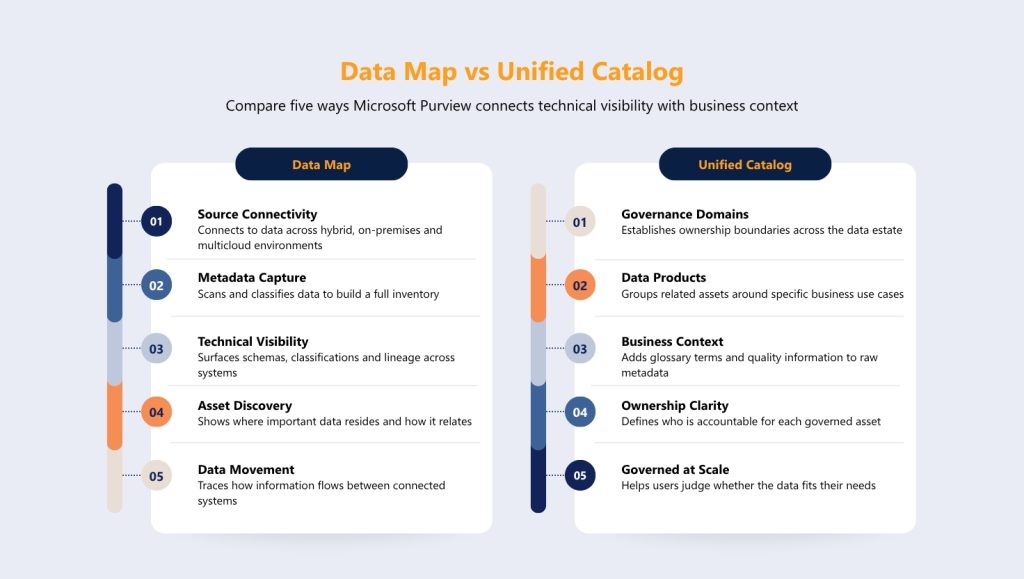
Microsoft Purview Data Map provides the technical foundation for governance. It connects to data sources across hybrid, on-premises and multicloud environments, then captures metadata through scanning and classification. This creates an inventory of data assets and provides visibility into information such as schemas, classifications and lineage, without moving the underlying data into Purview.
For an enterprise, this visibility establishes a common understanding of the data estate. Teams can identify where important data resides and how assets relate to one another, then trace how information moves between systems.
Microsoft Purview Unified Catalog
Unified Catalog builds on the metadata captured in Data Map by adding the business context needed to govern and use that data. Governance domains establish boundaries for ownership, while data products group related assets around specific business use cases. Glossary terms and ownership information, along with data quality and other governance concepts, then help users understand whether the data fits their needs.
Data Map establishes what data exists and how it is connected, while Unified Catalog helps organizations define what that data means, who is accountable for it, and how to govern it at scale.
Build the Governance Model Before Scaling Purview
Microsoft Purview can provide visibility across a large data estate, but expanding technical coverage should follow a clear governance model. Without one, organizations risk cataloging thousands of assets without establishing which data matters and who is accountable for it, then losing track of what standards should apply as the catalog grows.
1) Prioritize Critical Data
Start with the data that carries the greatest business or governance significance. This may include data supporting financial reporting, customer operations, regulatory obligations, analytics or AI workloads and repositories containing sensitive information.
Prioritization keeps the initial scope manageable and allows governance teams to establish working practices before expanding across the wider data estate.
In Purview, these priority sources can then be registered and scanned through Data Map to establish the metadata foundation for governance. Microsoft recommends the same approach: start with important, frequently used data rather than trying to govern the entire estate at once.
2) Establish Meaningful Governance Boundaries
Governance responsibilities should reflect how the organization owns and uses its data. Instead of recreating every technical system or organizational hierarchy, enterprises can establish governance domains around meaningful boundaries such as finance, customer data, human resources or regulatory requirements.
Purview Unified Catalog supports this model through governance domains, which distribute ownership across defined areas of the data estate. This allows domain owners and stewards to manage the data they understand while a central data function maintains organization-wide standards.
3) Define What Governed Data Looks Like
Finally, establish the minimum requirements that critical data should meet before it is considered governed. Depending on the organization, this may include an assigned owner, an agreed business definition, appropriate classification, documented lineage and defined quality expectations.
These standards give teams a consistent baseline as governance expands. Purview can then help operationalize them through metadata, data products, glossary terms, ownership and data-quality capabilities, rather than allowing the catalog itself to become the measure of governance success.
Establish Ownership, Quality and Trust
Once the governance model is defined, the next step is establishing accountability for the data within it. A dataset can be fully cataloged and still leave important questions unanswered, since cataloging alone does not say who owns its business definition, who answers when quality declines, or who decides whether the data is suitable for a particular use.
That accountability should sit with the people who understand the data and its business purpose. Platform teams may connect sources and maintain Purview, but that operational role does not make them responsible for the meaning or quality of the underlying data, which is why ownership needs to be assigned deliberately rather than assumed by whoever manages the system.
This is where distinct roles come in. Data owners provide business accountability, while data stewards maintain definitions and governance information, and data product owners manage how related assets are packaged for specific business use cases. Purview supports this distributed model through governance domains and defined governance roles.
Ownership alone is not enough unless it translates into measurable trust. In Unified Catalog, organizations can define data quality rules and evaluate dimensions such as accuracy, completeness, consistency, freshness, conformity and uniqueness, with quality scores then surfaced at the asset, data product and governance domain levels so users can judge whether governed data is fit for purpose.
That combination of clear ownership and measurable quality is what gives users enough context to make informed decisions about data. They should be able to find a relevant data product, understand its business purpose, identify its owner and assess its quality to determine whether it is appropriate for their intended use. This is where governance moves beyond creating an inventory and starts building trust in the data people actually use.
Connect Governance to Security, Access and Compliance
Enterprise data governance also provides the context organizations need to make informed decisions about access, security and compliance. When data is classified, tied to a clear business purpose, and assigned to an accountable owner, teams have a stronger basis for determining who should use it and under what conditions.
Microsoft Purview Unified Catalog supports this through access policies that can be associated with governance domains, data products, glossary terms and critical data elements. Organizations can define approval requirements and terms of use, while users can request access to governed data products through the catalog.
However, this governance context should not be confused with technical enforcement. Depending on the underlying data source, approval of a request may still require an access provider or asset owner to provision permissions within the source system, since governance defines the policy rather than the mechanism that carries it out. This distinction matters because effective governance connects business policy with technical controls, rather than assuming that cataloging or classifying sensitive data automatically secures it.
A Practical Roadmap for Implementing Enterprise Data Governance with Purview
Enterprise data governance is easier to operationalize in phases, starting with priority data and expanding once that foundation is proven. Microsoft follows a similar progression across Data Map and Unified Catalog, moving from governance domains and source onboarding to data products, business context and data quality.
Phase 1: Assess and Prioritize
Begin by identifying the systems that make up the data estate and the data that carries the greatest business value or risk, prioritizing sources by factors such as business importance, sensitivity, regulatory requirements and how widely the data is used. The goal is a manageable starting scope, such as customer or financial data supporting several critical processes rather than scanning every available repository.
Phase 2: Establish the Governance Foundation
Next, define how governance responsibilities will operate around the priority data by establishing governance domains, assigning accountable owners and agreeing on the standards governed data should meet. The technical foundation then follows in Data Map, registering and scanning the relevant sources so the inventory supports the governance model rather than developing separately from it.
Phase 3: Operationalize Governance
Once priority sources are available in Data Map, connect them to business context in Unified Catalog by creating data products around defined use cases, assigning owners, adding glossary terms and applying access and quality rules where needed. At this stage, governance becomes part of how teams discover and use data, not a separate documentation exercise.
Phase 4: Measure and Expand
Finally, measure whether the model is producing useful outcomes before expanding it, tracking indicators such as ownership coverage, data quality, metadata completeness and whether governed data products are actually being discovered and used.
Expansion can then follow business priorities, bringing in additional sources and domains while refining standards based on what teams learn, building a repeatable governance practice that scales alongside the estate.
Build Data Governance as an Ongoing Enterprise Capability
Enterprise data governance is not complete once data sources are cataloged or policies are defined. As the data estate changes, organizations must maintain ownership, context and quality so teams can keep finding and using trusted data.
That ongoing work is how we help organizations approach Purview as part of a broader governance strategy rather than a standalone deployment, aligning it with the data estate, ownership model and security requirements the business outcomes actually depend on.
If you are evaluating Microsoft Purview or looking to strengthen an existing enterprise data governance program, we can help you develop and operationalize a governance strategy that fits your Microsoft environment and scales with your organization. To get started, review our Microsoft Consulting services or schedule a 15-minute consultation.