Enterprises have spent years building governance frameworks for employees, software applications, and users with elevated privileges. AI introduces another entity to govern: a class of digital workers capable of getting things done with little human oversight. Many organizations still treat these agents as nothing more than very smart chatbots, an assumption that is quickly becoming a risk.
That shift fundamentally changes the AI agent governance conversation. Once an agent can act on behalf of a person or business process, the challenge moves from trusting what the AI says to deciding what it should be allowed to do.
A poorly behaved chatbot may frustrate a user. An AI agent with excessive permissions could expose sensitive information, approve unauthorized transactions, or change operational settings that affect thousands of people. As organizations deploy more agents across the business, governance must scale with that growth rather than collapse into red tape.
Doing that requires more than new policies. It starts with understanding why agents demand different controls than traditional AI. From there, enterprises need a single governance model that establishes who owns each agent, a permissions system that defines what each agent can do, and clear boundaries around the information agents can draw on when they act.
This article presents a practical approach to building that framework, so your teams can get on with innovating rather than managing risk after the fact.
3 Ways AI Agent Governance Is Different from Traditional AI Governance
Agents differ from traditional AI systems because they do more than generate responses. They take action, and that single difference changes almost every subsequent governance decision.
1) Agents Act, Not Just Respond
Traditional AI systems support human decisions. A chatbot answers a question, a recommendation engine offers a suggestion, and a predictive model estimates demand. In every case, the human remains responsible for acting.
Agents remove that final step. Once given a goal and the right permissions, they work independently, creating service tickets, provisioning cloud resources, sending customer emails, and triggering entire workflows.
Consider an IT operations agent handling infrastructure alerts. Rather than notifying an engineer and waiting for instructions, it might restart failed services, provision additional compute, update incident tickets, and notify stakeholders.
Every action an agent takes carries business consequences, from security and compliance to customer experience and the bottom line. Governance can no longer stop at evaluating output quality; It also has to control what an agent is allowed to do and when.
2) Governance Shifts from Output Quality to Action Control
That shift in responsibility changes the focus of governance itself.
Traditional AI governance asks whether a model performs well and operates fairly. It also asks whether decisions can be explained and whether bias has crept in. Those questions remain relevant, but they are no longer enough.
AI agent governance asks whether an action was authorized, whether the agent stayed within its assigned responsibilities, and whether a human should have approved it first. When something goes wrong, the questions turn to the audit trail and who is accountable.
These questions are closer to enterprise IT governance than to traditional AI governance, because the challenge is no longer limited to model quality alone. Once an agent can act independently, governance has to control the actions it is trusted to perform.
3) Why Delegated Authority Changes the Risk Model
If governance is now focused on controlling actions, the next question is how much authority an agent should be given.
Organizations have spent decades building governance for human decision-makers. Managers approve budgets within spending limits. System administrators receive privileged access based on their responsibilities, while finance teams follow segregation-of-duty controls before authorizing payments. These safeguards exist because authority creates risk.
AI agents deserve the same treatment. An agent that can reset passwords or approve purchases operates under delegated authority. The same is true of one that can modify cloud infrastructure or communicate with customers. If its permissions exceed its intended responsibilities, the risk is no different from giving an employee unrestricted administrative access.
Establish a Single Governance Model Across the Organization
As AI adoption expands, departments naturally begin to build and govern agents independently. Marketing develops content agents while HR deploys recruitment assistants. Finance automates approvals and IT introduces operational agents. Before long, each team is following its own governance process.
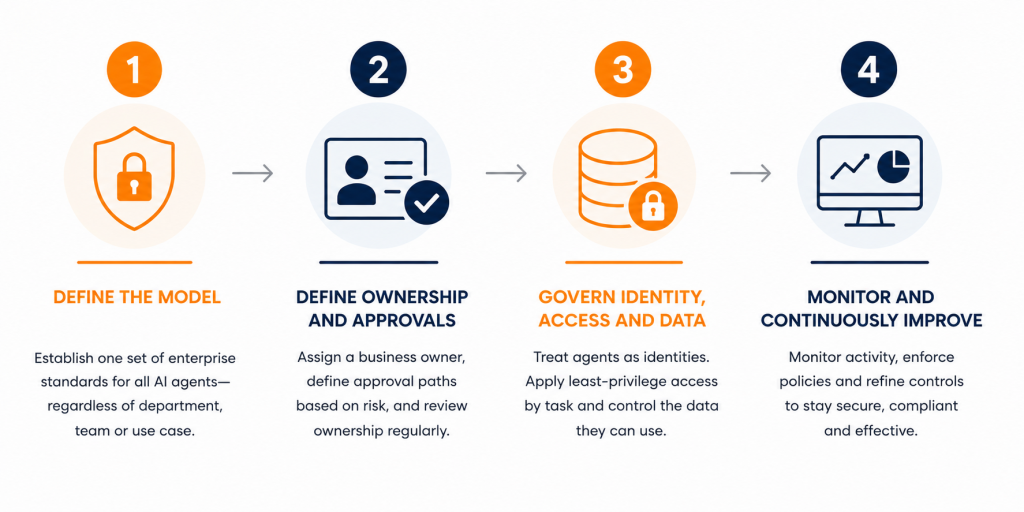
A centralized governance model solves this by applying the same enterprise standards to every AI agent regardless of where it operates.
What the Governance Control Plane is Responsible For
The governance control plane provides a single view of AI across the organization. It maintains an inventory of deployed agents and tracks who owns each one. Policy enforcement and activity monitoring run through the same layer to ensure controls remain effective over time.
Rather than allowing each department to define its own process, the control plane provides a consistent framework for approving and reviewing AI agents across the enterprise.
Define Ownership, Accountability and Approval Paths
Every AI agent should have a clearly identified business owner, not just a technical administrator. The owner approves the agent’s purpose and validates its permissions. The same owner reviews performance and responds to incidents while confirming the agent continues to deliver business value.
Ownership should also survive organizational change. Projects wind down and employees move into new roles as teams reorganize. Governance should therefore require regular ownership reviews. If no accountable owner can be identified, the agent should enter a formal review process to be restricted or retired if necessary.
Approval paths should follow the same principle. Routine low-risk activities may be executed automatically. Actions involving financial approvals or infrastructure changes should require human approval, as should anything touching regulated data or external communications.
Why a Unified Governance Model Matters
Multiple governance models rarely remain consistent. Over time, departments develop their own approval standards and monitoring practices along with their own definitions of acceptable risk. Leaders lose visibility into the organization’s overall AI posture and struggle to identify where meaningful risks exist.
A unified governance framework eliminates those blind spots by applying consistent policies and oversight across all AI agents, regardless of the department or technology involved.
Govern Identity, Permissions and Tool Access as One System
With ownership and accountability established, the next step is defining what AI agents can and cannot do. Many organizations focus on protecting data while overlooking operational permissions, even though both deserve equal attention. An agent capable of reading confidential information poses one type of risk. An agent that can modify systems and communicate externally presents another.
Effective AI governance treats identity, permissions, and tool access as one connected system.
Treat Agents as Governed Identities
A common mistake is treating an AI agent as a software feature instead of an enterprise identity. Once an agent can interact with business systems, it should be integrated into the organization’s identity and access management framework. Like employees and service accounts, agents need unique identities and authenticated access. They also need well-defined permissions, audit trails and lifecycle management.
This approach builds on the controls organizations already have in place. Rather than creating a separate governance model for AI, it extends existing identity and access management practices to digital workers.
Define Least-Privilege Access by Task
Permissions should reflect the work an agent performs rather than the department that owns it.
A procurement agent approving low-value purchases may need access to procurement workflows, supplier records and purchasing policies. It should not have unrestricted access to enterprise finance systems.
Defining permissions around specific tasks reduces risk and makes access reviews simpler and more consistent.
Separate Data Access from the Ability to Act
Reading data and acting on it are two distinct capabilities that governance should treat as such.
An agent may need broad access to customer information to analyze complaints, but that does not mean it should automatically send responses to customers. Likewise, an infrastructure agent may monitor production systems continuously while still requiring human approval before making changes.
Separating data access from execution helps organizations benefit from AI without giving agents more authority than they need.
Control the Data Agents Can Rely On
An AI agent is only as reliable as the information it uses. It gathers context from enterprise documents and databases before it can answer a question or take action.
Why Oversharing Becomes an Agent Problem
People naturally use judgment when deciding what information to share, but AI agents do not. They retrieve information from available sources and use it to answer questions or complete tasks.
If those sources include confidential documents or outdated procedures, the agent will continue surfacing that material at scale. What starts as a data management issue quickly becomes a governance problem.
The safest approach is to define exactly which knowledge sources each agent can access rather than assuming it should inherit everything the organization knows.
Govern Data Before Prompts
Prompt engineering receives a great deal of attention because it is visible and easy to change. Data governance has a much greater impact on safety in practice because an agent cannot expose information it does not have access to.
If an agent can retrieve sensitive or outdated information, changing the prompt will not reliably prevent it from appearing in responses. Restricting the underlying data is far more effective than trying to control every possible interaction.
Separate Internal Access from External Actions
Many enterprise agents operate across both internal and external environments. Internally, they draw on knowledge bases, operational documentation and customer records. Externally, they communicate with customers, suppliers, and partners.
Those capabilities should be governed separately. An agent that can access confidential engineering documents should not automatically be allowed to share that information externally. Likewise, access to HR policies does not justify exposing employee information outside the organization.
Separating internal data access from external actions helps prevent accidental disclosure while allowing agents to work effectively within clearly defined boundaries.
Conclusion
AI agents are reshaping how enterprises operate. They no longer just produce information; they manage workflows, adjust systems, and make operational decisions. In some cases, they stand in for employees across the business.
That shift demands a governance posture built around control. The central question has moved from whether an AI’s output can be trusted to what the agent should be allowed to do. Organizations that treat AI agents as governed members of their digital workforce with clear boundaries on the data they can access will be the ones that scale automation safely.
But strong agent governance starts with a strong data foundation. If your agents are relying on data you can’t fully see or control, that’s where the risk begins. Our Microsoft Data Security Workshop helps you uncover where sensitive data lives, how it’s being used, and where you’re exposed, so you can put the right guardrails in place before you scale AI adoption.
Using the Microsoft technologies you already own, CrucialLogics helps you innovate without sacrificing visibility, accountability, or control. Book your Microsoft Data Security Workshop today or learn how we can provide your organization with AI Governance consulting and training.