Enterprise AI adoption has outpaced the governance structures needed to manage it. In most organizations, the shift from isolated pilots to production-grade systems happened without a corresponding shift in how those systems are owned, monitored, or controlled.
AI does not behave like traditional software. It pulls data it was never trained on, generates outputs that vary across departments, and drifts from its baseline guardrails on data exposure. For executives, an AI governance error is less a problem with the model itself and more a failure of the governance frameworks and compliance guardrails put in place to prevent it.
Beyond policy documents, enterprises with functional AI governance models treat governance as a consistent, repeatable operational capability.
5 Core Components of an Enterprise AI Governance Framework
Governance maturity is not measured by the number of policies an organization has produced. It is determined by whether those processes can be applied consistently as new AI systems enter the enterprise. These components each serve a distinct function, and their value is only realized when they operate together as a single governance model.
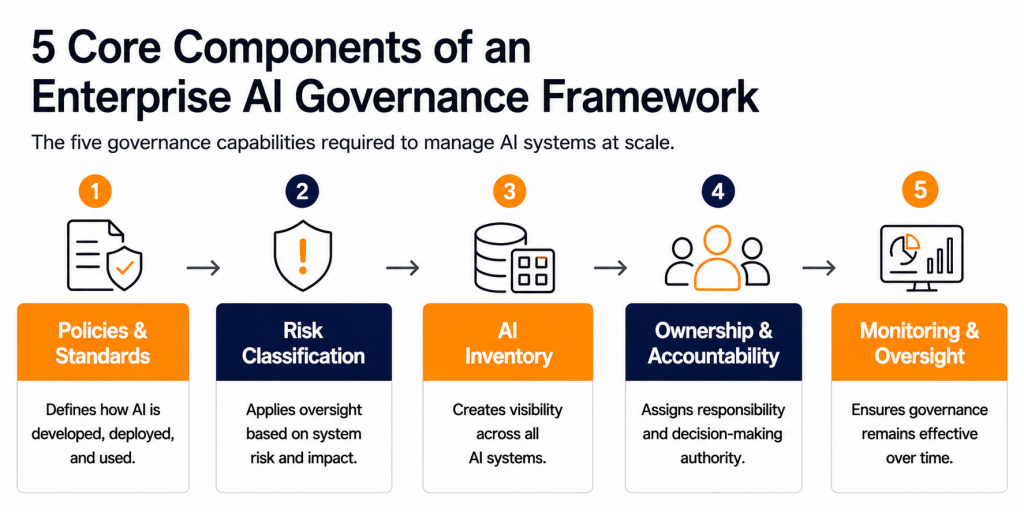
1) Governance Policies and Standards
Governance policies and standards establish the rules for how AI is developed, deployed, and used across the organization: acceptable-use boundaries, documentation requirements, data-handling expectations, security controls, approval processes, and escalation procedures for higher-risk systems. Without clearly defined standards, governance defaults to individual judgment rather than consistent oversight at scale.
2) AI Risk Classification
A productivity assistant summarizing meeting notes requires a different level of scrutiny than a system influencing financial decisions or regulatory outcomes. Risk classification allows organizations to apply governance controls proportionate to that difference. Factors such as data sensitivity, degree of automation, business impact, regulatory exposure, and decision reversibility determine the appropriate level of oversight.
3) AI Inventory and System Registration
Organizations cannot govern systems they cannot identify. Different business units increasingly deploy AI-enabled tools independently, and those deployments rarely surface in central IT visibility. A formal inventory provides a centralized record of each system’s purpose, owner, data sources, risk classification, deployment status, and compliance requirements. It is the foundation on which risk assessments, audits, monitoring, and regulatory reporting all depend.
4) Roles, Ownership, and Accountability
Every AI system requires a clearly defined business owner responsible for the outcomes it influences and a technical owner responsible for its operational integrity. Governance failures occur most often not because policies are absent but because responsibility is unclear. When ownership is spread across teams without clear decision-making authority, issues go unresolved and risks remain unaddressed.
5) Monitoring and Continuous Oversight
AI systems operate in environments that continually change, and as those changes accumulate, performance can diverge from the conditions under which the system was originally assessed.
Continuous monitoring provides visibility to identify performance degradation, policy violations, and emerging compliance risks. Regular reviews then determine whether a system continues to operate within approved parameters and whether its risk classification remains appropriate.
- Related resource: Enterprise AI Governance Framework: Build and Operationalize at Scale
How to Operationalize an Enterprise AI Governance Operating Model
Understanding what needs to be governed is only part of the challenge. Organizations also need a consistent way to evaluate, approve, monitor, and retire AI systems as they move through the enterprise. Most governance programs lose ground at this stage because the distance between documented policy and operational practice is large. In some cases, risk decisions get pushed to deployment, approvals get bypassed under deadline pressure, and post-launch monitoring gets deprioritized the moment the immediate pressure of going live has passed.
The most practical approach is to embed AI governance within existing operational processes rather than build a parallel track alongside them, as the latter is easier to bypass.
A practical AI governance operating model treats every AI initiative as a lifecycle, with defined entry criteria, approval checkpoints, and ongoing accountability at each stage.

Step 1: AI Use Case Intake
Governance that starts at deployment is already too late. By the time a system is ready to go live, the organization has already committed to a vendor, a dataset, an architecture, and a business case. Reversing any of those decisions is expensive.
A formal intake process moves governance to the beginning of that sequence. Before resources are committed or technology decisions are made, intake activities define the proposed use case: its business objectives, expected outcomes, intended users, data requirements, integration points, and regulatory or risk considerations.
That early visibility allows governance teams to surface higher-risk initiatives before resources are locked in and gives business leaders a clearer basis for prioritization before commitments are made. More importantly, it establishes governance at the point in the lifecycle where course correction is still manageable.
Step 2: Risk Assessment and Approval
Not every AI initiative carries the same level of risk. A productivity tool that summarizes internal documents requires less scrutiny than a system that influences clinical decisions, financial outcomes, or regulatory compliance, and risk classification provides the mechanism for making that distinction.
Risk assessments evaluate factors such as data sensitivity, business impact, degree of automation, regulatory obligations, third-party dependencies, and the potential consequences of incorrect outputs. Those assessments inform the system’s risk classification and determine the governance process it must follow.
Higher-risk systems require review from multiple stakeholders, including business leaders, security teams, legal representatives, and technical architects. Lower-risk initiatives can move through a simplified process without bypassing baseline requirements, though no AI system should advance into development without a documented risk assessment and formal approval. Governance becomes significantly harder to enforce when those decisions are pushed to deployment.
Step 3: Development and Validation Controls
Development is where governance requirements most often lose ground. Once a project is funded and resourced, the pressure to ship tends to outweigh the discipline to validate. The result is systems that reach production without adequate documentation, security reviews, or evidence that governance requirements from the assessment phase were actually addressed.
Before any system reaches production, development teams should be able to demonstrate how models were selected, which data sources were used, how outputs were evaluated, and what controls are in place to manage identified risks. Validation confirms that the system performs as intended in its operating environment and that governance requirements from the assessment phase have been met. Issues caught at this stage are resolved before they become production incidents.
Step 4: Deployment Governance
Deployment is the final governance checkpoint before a system becomes operational, though most organizations treat it as a launch event rather than a control gate.
Before release, organizations should confirm that all required approvals are in place and that ownership responsibilities are clearly assigned. The operational baseline, including monitoring controls, incident response procedures, and performance thresholds, should be in place before go-live, not scheduled for implementation afterward. Business stakeholders should understand the system’s purpose, its limitations, and the circumstances under which human review or escalation is required.
Step 5: Production Monitoring and Review
Most governance programs treat production as the finish line. In practice, it is the beginning of the most sustained governance responsibility. AI systems operate in environments that continually change, and as conditions shift, system performance can diverge from the baseline under which it was originally assessed and approved.
Continuous monitoring provides visibility to detect performance degradation, policy violations, and emerging compliance risks before they become incidents. Regular reviews determine whether a system continues to operate within approved parameters and whether its risk classification still reflects actual operating conditions. The most effective programs embed these reviews in existing operational cadences rather than running them as separate governance exercises.
Step 6: Retirement and Decommissioning
Governance responsibilities tend to disappear when a system is no longer actively used, and it is one of the more predictable gaps in any AI governance program. Every AI system eventually reaches the end of its operational life, whether through replacement, changing business requirements, or failure to meet current performance or compliance standards.
Governance should define how those transitions are managed before they happen, not after. Retirement activities typically include data retention and disposal, removal of system access, updates to the governance inventory, and documentation of lessons learned. Formal decommissioning ensures that residual risks are addressed and that governance responsibilities remain active until the system is fully closed out.
Governing Generative AI and Agentic Systems
The lifecycle above applies most directly to AI systems with a defined scope and a bounded function. Generative AI changes that assumption.
A single generative AI system can support multiple business functions, access information from multiple sources, and influence decisions across the organization simultaneously. As AI becomes connected to platforms such as SharePoint, Teams, CRM systems, and internal knowledge repositories, governance shifts toward questions of access and control.
Agentic systems extend that challenge further. When a chatbot generates information for a person to review before acting, an agent can perform the action directly. It can create records, update systems, trigger workflows, and interact with business applications on behalf of a user without requiring human review at each step. That shift changes the governance challenge from managing outputs to managing actions.
Organizations should define clear boundaries around what an agent is permitted to do, where human approval is required, and how activities are monitored once a system is operating in production. Those controls become increasingly important as organizations grant AI systems access to sensitive data and business-critical processes. For many enterprises, this represents the next stage of AI governance maturity. Success depends less on the model being used and more on the organization’s ability to control access, enforce permissions, maintain visibility, and retain accountability as AI systems become more capable.
How Leading Frameworks Support Enterprise AI Governance
Establishing those controls requires a governance model grounded in recognized standards. Governance maturity depends less on adopting a specific framework and more on understanding the role different frameworks play within the broader governance model. No single framework covers everything required to govern AI at scale, and each addresses a different dimension of the challenge.
1) ISO 42001: Structure
ISO 42001 provides the management system that supports long-term governance. It establishes requirements for accountability, documentation, reviews, and continual improvement. Those requirements create the organizational structure needed to govern AI consistently across teams, business units, and use cases.
2) NIST AI RMF: Risk
NIST AI RMF provides a practical approach for identifying, assessing, and managing risk throughout the AI lifecycle. Its value lies in helping organizations determine where oversight should be concentrated and how governance controls should be applied. Those assessments influence approval requirements, review frequency, monitoring activities, and accountability expectations. As a result, risk management becomes embedded within the governance process rather than treated as a separate activity.
3) OWASP and MITRE: Controls
While risk assessments identify where attention is required, security frameworks help determine how to address those risks. OWASP and MITRE document common attack paths, vulnerabilities, and misuse scenarios that affect AI systems. This guidance helps organizations translate governance requirements into technical controls that can be implemented, tested, and monitored in production environments.
Enforcement Within the Microsoft Ecosystem
Governance ultimately depends on the ability to enforce decisions after they have been made. Within Microsoft environments, that control layer is delivered through a combination of identity governance, information protection, and security monitoring capabilities.
Microsoft Entra governs access to enterprise resources and helps ensure AI applications and agents operate within defined permission boundaries. Microsoft Purview extends those controls into the data layer by applying classification, protection, and compliance policies to the information that AI systems can access. Microsoft Defender provides visibility into activity across the environment, and security teams use that visibility to detect misuse, investigate incidents, and monitor emerging threats that may affect AI-enabled workloads.
Conclusion: Enterprise AI Governance as an Ongoing Capability
Enterprise AI governance is not defined by the frameworks an organization adopts. It is defined by the organization’s ability to apply governance consistently across AI systems as they move from intake and assessment through deployment, monitoring, and retirement. Organizations that scale AI successfully establish clear ownership, risk-based oversight and enforceable controls.
At CrucialLogics, we help organizations build that capability within the Microsoft ecosystem. Our approach combines governance frameworks, security controls, and Microsoft-native technologies such as Entra, Purview, and Defender. Together, they provide the visibility, access controls, and monitoring required to govern AI in production.
If your organization is evaluating AI governance, planning a Copilot rollout, or exploring agentic AI use cases, we can help you establish the governance structures, operational controls, and Microsoft security foundations needed to support AI adoption at scale. To get started, fill out this form, and one of our experts will be in touch.